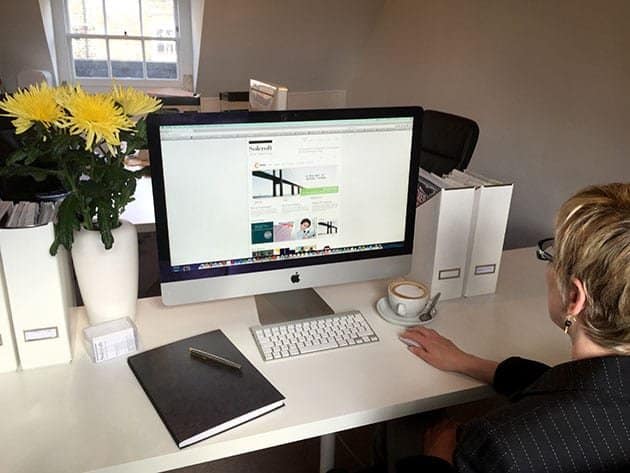
Stacey Jackson took a massive step when she left corporate life to start her own business, a process that began with learning how to write a business plan. She needed more challenge and more balance in her life. Failure wasn’t an option. In this Q&A, the Solcroft founder shares how she made the transition, what is a limited company, and what she has learned along the way.
Tell us about your business
Today, Solcroft is a London-based communications consultancy that works with public and private sector clients on corporate and marketing communications. The team writes, designs and produces everything from annual reports and stakeholder brochures to campaign content and academic-style research documents. What Solcroft brings to complex projects is the ability to dissect information, reinforce an argument and draw clear, compelling conclusions – skills Stacey developed through her own academic study.
Projects span sectors from healthcare to telecoms, and the client base includes UK organisations as well as European bodies. Over the years the business has grown from a desk under the stairs into a studio supported by a core team and a network of trusted freelancers.
What motivated you to start your own business?
Stacey always wanted to stretch herself, but the real push to set up Solcroft came from realising there was far more she could achieve. To reach her potential, she needed to build something from the ground up.
After a maths degree and a satisfying career at the BBC World Service and Thomson Holidays (now part of TUI), she found herself treading water in corporate management roles after her daughter was born. Evenings gave her time to think, and she began to see that she could challenge herself far more, both academically and professionally. Her decision also mirrors a wider shift in the UK: more women are leaving corporate careers to start businesses that offer greater flexibility, autonomy and long-term fulfilment.
How did you get started?
Stacey knew early on that she wanted to start a communications company. The challenge was pursuing that goal while working full time and raising her daughter. She found the answer through The Open University, studying for a Master’s Degree in Art History by distance learning.
The degree was an eye-opener. It taught her academic writing, rigorous research and time management, and it demanded extraordinary discipline. Every Saturday and most evenings from 6pm to 10pm went into her studies. Completing the degree gave her the confidence that she could start and finish something difficult – and that belief carried straight into her business.
In the beginning, she worked from a desk under the stairs and forced herself to make 100 cold calls a day until she established a client base. It took the same commitment as finishing her degree. During Solcroft’s early years she often worked long hours, seven days a week, because she knew that anything less than total commitment would not be enough.
What are your values?
Stacey gives 100 per cent to every client and every job, however big or small.
What marketing tactics work best for your business?
Loyalty matters. Solcroft’s clients know that if something goes wrong – a printer lets them down, a deadline shifts, a brief changes – they can call Stacey and she will find a solution. Marketing, she believes, is not just about the work itself but about genuinely caring about clients.
She also never forgets that the consultancy is a service. It is Solcroft’s job to make things happen within the client’s budget and deadlines, not the other way around.
What were the toughest challenges?
Building the client list and team was slow at first. Then bigger names started coming in and the pieces began to fit together. A defining moment was winning a long-term project with a major international organisation, which showed Stacey that the business had real momentum.
How have you funded the business?
Clients move on for all sorts of reasons – budget cuts, new marketing directors, changing priorities – and a consultancy has to be prepared. Stacey has never taken external funding for Solcroft, so the business has had to stay resilient and self-sufficient. When a major client moved on, it took time to rebuild the pipeline, but the company recovered and the experience underlined the importance of not becoming over-dependent on any single client.
Rather than cold-calling existing contacts, Solcroft keeps in touch with a concise, creative email newsletter when there is something interesting to say. It is a polite reminder of the company’s existence and has proved a successful approach.
What are the high points?
One of the biggest rewards of owning the company is control over her own time. Stacey has built a strong team and can fit family responsibilities – school meetings, school holidays, time with her daughter – around her working day. When she needs to switch off, she relies on her two greyhounds for a walk or starts the day with a swim, which gives her thinking time away from her phone.
She has always been driven, and she does not believe failure is an option. That mindset, she says, has been vital to Solcroft’s survival and growth.
Who has inspired you and why?
Stacey is not inspired by one person in particular. Her motivation comes from wanting to be the best she can be. That said, her dad is always there with the right answer when she needs it.
Three things you have learned
- Don’t underestimate thinking time. Protect some ‘me-time’ every day, even if it is just ten minutes, and you will see things more clearly.
- Get the best people around you, then delegate as much as you can.
- Don’t assume running your own business means working from a laptop in fancy cafes on a three-day week. If you want to succeed, it is a real slog.
Your best piece of advice
Stacey’s goal is to keep growing the business, keep learning and be there for her daughter. Her best piece of advice is simple: believe in yourself always – or pretend you are someone else that you do believe in.