

Latest statistics on female entrepreneurs, business owners, self-employed women, and business leaders in the UK.
Data compiled from primary sources including: UK Government, ONS, the Rose Review, and Prowess research. Updated annually.
Key Facts at a Glance
-
Women now represent one in three UK entrepreneurs, reflecting a 36% increase in business ownership since 2015. If women started and scaled businesses at the same rate as men, it could add £250 billion to UK GVA.
Source: Rose Review Progress Report 2024; ONS Business Population Estimates 2025. -
1.8 million women now run incorporated or self-employed ventures across the UK — the highest share on record.
Source: ONS Labour Force Survey 2025. - But the share of women-led employer SMEs has fallen from 19% to 14% since 2021. That is a loss of an estimated 70,000 firms. Source: Longitudinal Small Business Survey 2023.
-
Older women (50 +) are the fastest-growing group of entrepreneurs, now accounting for one in four female business owners.
Source: ONS Labour Force Survey, Age and Employment Dataset 2025. -
Female founders secured only 1.9% of total UK venture-capital investment in 2024, though the number of mixed-gender founding teams continues to rise.
Source: British Business Bank, UK VC & Diversity Report 2024. -
Women employ an estimated 2.7 million people through their SME employer firms, contributing over £250 billion to the UK economy each year.
Source: DBT SME Business Statistics 2025. -
43% of FTSE 350 board positions are now held by women, reflecting progress in leadership representation.
Source: UK Government FTSE Women Leaders Review 2024.
Compiled by Prowess.org.uk — supporting women in business and enterprise across the UK.
For a comprehensive overview see our latest report: The State of Women’s Enterprise 2025.
If you can’t find the information you’re looking for on this page, use the internal ‘search’ box (top right) – the Prowess site is full of research-based articles.
Latest UK Women in Business Statistics
There are different ways of defining women in business. Below we list the main ways women involved in entrepreneurial activity are defined by the main datasets. There is some overlap between each of the groups.
Female-led Companies 2026
What the data from Companies House tells us.
- Currently, 19.1% of active UK companies are female-led.
- There are almost One Million women-led companies in the UK. The current figure is 914,000 (down from 997,090 the previous year).
- The pace of company registrations has grown by 5% on the previous year, with 182,200 female-led incorporations in 2025, but this has been outpaced by the number of closures.
Self-employed women
Government statistics define self-employment by asking respondents to the quarterly Labour Force Survey ‘are you employed or self-employed?’ So it is self-defined. Other definitions include people working on their own account and being responsible for reporting their earnings individually to the tax office through self-assessment.
- There are 1.6 million self-employed women in the UK, and 2.74 million self-employed men.
- Women comprise 37% of all self-employed workers, up from 27% in 2007.
- Around 10% of women are self-employed compared with 16% of men, although the share of all self-employed workers who are women has increased over the past decade. (ONS 2024)
- During the pandemic, the self-employment rate collapsed to 2015 levels, for women and men, and has yet to recover. Between early 2020 and late 2022, the number of self-employed women fell by 119,000. (ONS March 2023)
- Just over half of self-employed women are professional freelancers and women are well represented in freelancing, comprising 42% of the group. (IPSE 2022)
- Self-employment is a long-term solution for a lot of women. Almost half of self-employed women (46%) have been self-employed for over six years, whilst 44 per cent have been self-employed for over nine years. (IPSE 2022)
Female Entrepreneurs
Female entrepreneurs are variously defined as those owning or running a new business, those who’ve registered a new company and those who are seeking growth capital.
- In 2022, women in the UK established over 150,000 new companies – more than twice as many as in 2018. (Rose Review Progress report 2023)
- One-fifth (20.5%) of all new company incorporations in 2022 were all-female led, up from 16% in 2018. (Rose Review Progress report 2023)
- One in ten working women in the UK is involved in start-up entrepreneurial activity. This is defined by the Global Entrepreneurship Monitor as those involved in ‘total early-stage entrepreneurial activity’ (TEA), that is owning or running any business that is less than three-and-a-half years old. In the UK the TEA rate (the proportion of working-aged people involved in TEA) for men is 15.1% and 10.7% for women. (GEM 2024)
- Only 1 in 3 UK entrepreneurs is female: a gender gap equivalent to 1.1 million missing businesses. (Rose Review of Female Entrepreneurship, HM Treasury 2019)
Female-led small and medium enterprises (SMEs)
The UK government’s definition of an SME is any company with less than 500 employees. It includes companies with no employees.
- In 2021, 19% of small and medium-sized enterprise (SME) employers were led by women (meaning that they were either led by one woman or by a management team that is majority female). This is similar to figures since 2015. This was a three percentage point increase on the 2020 figure of 16%. (BEIS 2022)
- The proportion of SMEs with no employees that were owned or led by women was higher, at 20% in 2021, around the same as in 2020. (BEIS 2022)
- Examining only SMEs with employees, women-led businesses were most likely to be in education (44%), health (37%), arts and entertainment (31%), other services (30%) and accommodation and food (29%) sectors. ‘Other includes personal services such as hairdressing and beauty. (BEIS 2022)
Women on Boards
- In January 2024, 42.6% of FTSE100 directorships were occupied by women and around half of all new FSTSE100 board appointments were women (47%).
- Nearly three-quarters of all FTSE100 Boards have at least 40% women on their boards – the current voluntary target set by the FTSE Women Leaders Review.
- In January 2024, 41.8% FTSE250 directorships and 42.1% of FTSE350 directorships were held by women.39
- There has been a massive increase in the number of female directors in top companies since a government-backed target of 25% female representation was set in 2015.
The Economic Case for Women’s Enterprise
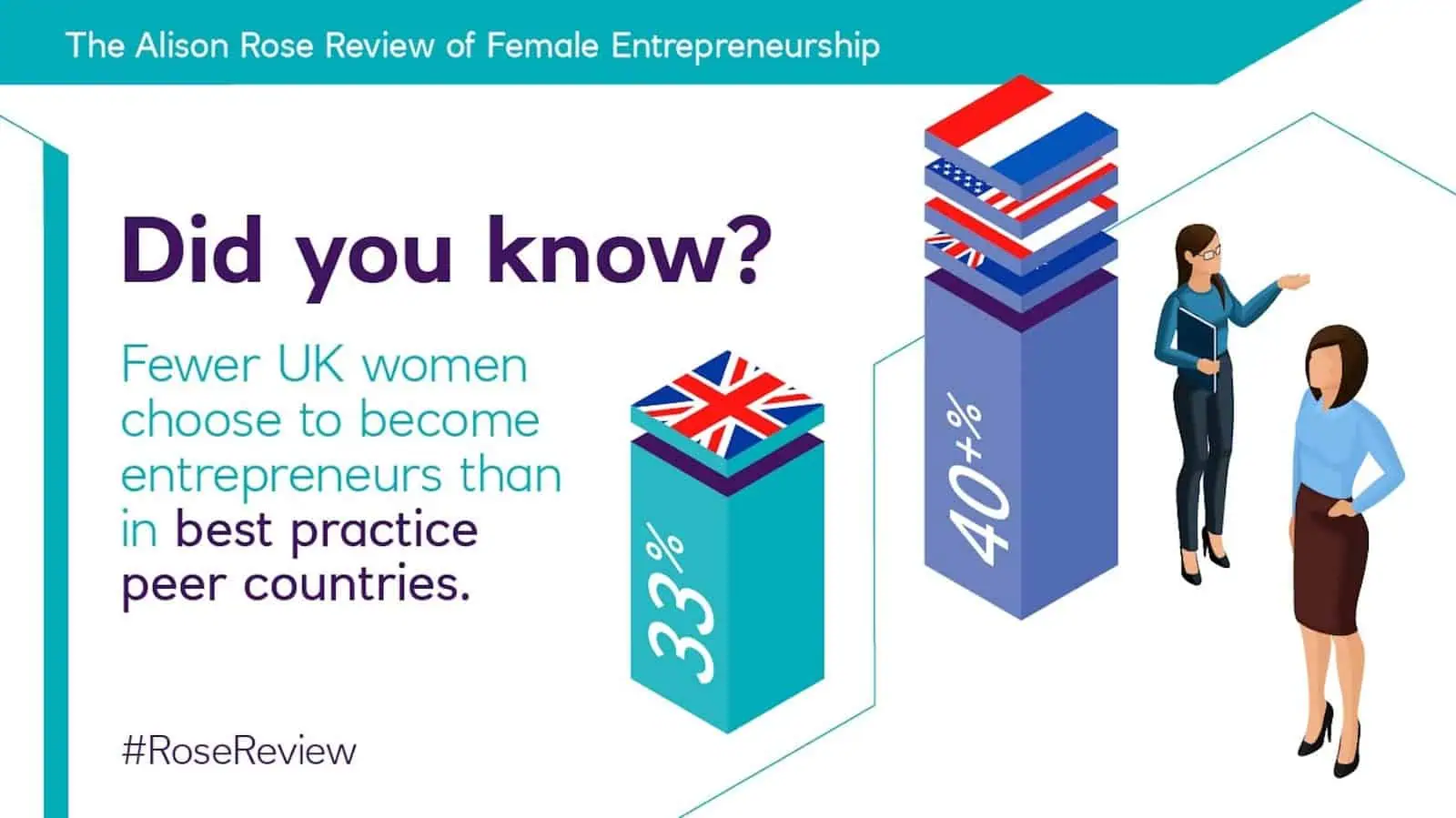
- Up to £250 billion of new value could be added to the UK economy if women started and scaled new businesses at the same rate as UK men. Even if the UK were to achieve the same average share of women entrepreneurs as best-in-class peer countries, this would add £200 billion of new value to the UK economy (Rose Review of Female Entrepreneurship, HM Treasury 2019)
- Placing greater value on female-dominated personal and social services, community and social services is an important part of decoupling prosperity from pollution-based growth. (‘Prosperity without Growth’, Jackson, 2009).
- Increasing numbers of women are studying science, engineering and technology (SET) degrees, but over 70% drop out of SET careers, compared with half of men. This is a huge waste of investment, talent and opportunity, especially as the key challenges of our time – renewable energy, food security, medical advances – require diversity of technical and societal engagement. (UKRC for women in SET 2011)
Gender differences in motivations for starting a business
- Women enter self-employment optimistically seeking greater control over working hours (63%), choice of where to work (56%) and better work-life balance (55%). (IPSE 2022).
- Flexibility around family care is the #1 reason to start a business for women with children. (Rose Review of Female Entrepreneurship, HM Treasury 2019)
- Women were nearly five times more likely to mention family reasons for becoming self-employed than men. A fifth of females chose to work as self-employed to help combine ‘family commitments/wanted to work at home’ and employment in a flexible manner. Conversely, men were almost twice as likely to say that one of the reasons they became self-employed was to ‘make more money’ than women. (ONS Regional Trends, Women in Business 2009).
Gender differences in attitudes to starting a business
- Women were 55% more likely than men to cite fear of going it alone as a primary reason for not starting a business. (Rose Review of Female Entrepreneurship, HM Treasury 2019)
- Women are less likely to believe they possess entrepreneurial skills: Only 39% of women are confident in their capabilities to start a business compared to 55% of men. This is a perceived gap in ability, rather than an actual gap in skill sets. (Rose Review of Female Entrepreneurship, HM Treasury 2019)
- Only 8.6% of all UK women surveyed in the Global Entrepreneur Monitor in 2017 said they plan to start a business in the next three years, compared to 14.3% of men (Global Entrepreneurship. Women’s Entrepreneurship 2016/2017 Report, report, 2017.)
- More than half of self-employed women (53%) work part-time compared to 17% of self-employed men. (ONS Labour Market Statistics, September 2014)
- Established women-owned businesses are more ambitious than their male counterparts. (GROWE Report, Women’s Enterprise Task Force 2009).
- Women start businesses under-capitalised. It’s not just lower financial capitalisation, women also have lower levels of human (management training and experience) and social (effective networks) capital. This under-capitalisation hinders women’s prospects and also their confidence in their ability to start a business. While studies often suggest female entrepreneurs are held back by risk aversion and low confidence, in fact ‘it is likely that this is not an individualised problem of self-confidence but more an informed assessment’ about how well prepared they are. (Women in Enterprise: A Different Perspective, RBS Group 2013).
Facts About Female Innovators and SET Entrepreneurs
- Women remain significantly under-represented in UK innovation and STEM-based enterprise. According to the UK Innovation Report 2023 from Innovate UK, only 14% of UK innovation-active firms are women-led, despite women representing half of the graduate workforce. Source: Innovate UK, UK Innovation Report 2023.
- Patent activity shows a persistent gender gap. The UK Intellectual Property Office (Intellectual Property Office) reports that fewer than 1 in 10 UK patents list a woman inventor. While the number of women patent applicants has been rising, progress remains slow. Source: UK IPO, Gender Profiles in UK Patenting 2023.
- Women-led high-tech businesses receive disproportionately low levels of equity investment. According to the British Business Bank 2024 UK VC & Female Founders Report, all-female founding teams secured just 2% of UK equity investment in 2023, with STEM ventures showing the largest gaps. Source: British Business Bank, UK VC & Female Founders 2024.
- In deep tech and applied R&D, women-founded firms form less than 10% of all UK spinouts originating from universities. Source: Octopus Ventures, “University Spinout Report 2023”.
- Women researchers and innovators are more likely to lead interdisciplinary or socially-focused innovation projects, yet they remain less likely than men to secure large-scale R&D grants. The Horizon Europe UK participation analysis 2023 found women principal investigators accounted for only 21% of UK-led bids. Source: UKRI Horizon Europe UK Participation Report 2023.
- Within STEM entrepreneurship ecosystems, women face structural participation gaps. The Global Entrepreneurship Monitor UK 2023 reports that women are 45% less likely than men to engage in STEM-based early-stage entrepreneurship. Source: GEM UK Report 2023.
- Women continue to be under-represented in high-growth tech sectors. The Tech Nation 2023 review found that women-founded tech businesses represented just 9% of UK high-growth tech firms, and these firms were less likely to receive scale-up funding rounds. Source: Tech Nation, “Future UK Tech Economy 2023”.
- Despite under-representation, outcomes remain strong. Innovate UK’s Women in Innovation Programme Impact Report 2023 found that supported women innovators achieved 25–30% higher subsequent grant success rates and significantly higher growth probabilities compared with sector averages. Source: Innovate UK, Women in Innovation Impact Report 2023.
Facts about Access to finance for female entrepreneurs
- Women-led companies received just 5.8% of all investments in 2024. (Gender Index 2025)
- Women-led businesses receive smaller amounts of loan finance. The gap widened in 2022, with the average (mean) amount approved for women-led businesses standing at £174,000 – 34% of the average of £507,000 approved for their male-led counterparts. (Investing in Women Code Annual Report 2023)
- Around one-third of women say access to funding is the biggest barrier to starting a business, compared to 20% of men. A similar proportion cites funding as a barrier to scaling up an existing business. (Rose Review of Female Entrepreneurship, HM Treasury 2019)
- Only 1% of all venture funding goes to businesses founded by all-female teams, inhibiting scale-up (UK VC & Female Founders, report, February 2019.)
- Women-led businesses achieve far lower levels of equity investment, with male entrepreneurs 86 per cent more likely to be venture-capital funded, and 56 per cent more likely to secure angel investment. However, when they do secure investment, women’s businesses show returns of 20 per cent more revenue with 50 per cent less money invested (Untapped Unicorns, Female Founders Forum/ Barclays 2017)
- In 2016, 91 per cent of investment by value was directed into companies without a single female founder, while just 9 per cent went to companies with at least one.
- (Untapped Unicorns, Female Founders Forum/ Barclays 2017)
- Women are around ten per cent more likely than men to see finance as their only barrier to entrepreneurship. Education and training reduce the difference. (Kwang, Jones-Evans and Thompson. 2012)
Facts about women-friendly business support, skills and training
- Women who have undergone some form of enterprise training are twice as likely to be engaged in entrepreneurial activity (GEM UK 2005).
- Labour Force Survey data shows that only 12 per cent of the UK’s solo self-employed (the 92% of the self-employed without employees) have received job-related training in the last three months, compared to 26 per cent of employees. (IPSE 2020).
- Following a sustained strategy to make its services more women-friendly, the national Business Link service increased its proportion of female clients from one-fifth to one-third, between 2003 – 2006. (GROWE Report, Women’s Enterprise Task Force 2009)
- Targeted Women’s enterprise initiatives complement and add value to mainstream business support services located nearby. The West Midlands Regional Women’s Enterprise Unit (RWEU) found that 58% of their clients in 2007 had not previously used ‘mainstream’ business support. A 2008 analysis found this figure had risen to 90% (Impact Assessment, RWEU 2008).
- 38% of women in the UK compared to 3% in Europe take advice from government business support. Women are more likely to use all forms of business support, whether public or private sector or informal in origin than men. They are more likely to access support from professional services, banks and governments than their European counterparts. (‘Challenges and Opportunities for Growth and Sustainability (COGS): A focus on women in the UK and Europe’. Delta Economics, 2011)
- People who have taken up entrepreneurship training are three times more confident about having the skills to run a business. (GEM Special Report: A Global Perspective on Entrepreneurship Education and Training, 2010).
Facts about self-employed women and childcare
- In the UK there are a total of 611,000 solo self-employed mothers, around half (302,000) of whom are working as freelancers. The number of solo self-employed mothers increased by 61 per cent between 2008 and 2020 (Women in Self Employment Report. IPSE 2020)
- Self-employed women with caring responsibilities, in England and Wales, receive less support than employed women. They return to work more quickly after having children and usually have little or no self-employed maternity pay or maternity cover. (Limmer 2012)
- Self-employed mothers are not entitled to Statutory Maternity Pay. Instead they can claim a Maternity Allowance (£151.20 per week or 90% of average gross weekly earnings whichever is the smaller amount) and can work up to ten Keeping in Touch (KIT) days to maintain their business. (IPSE 2020)
- Only one third of self-employed mothers take the full 39 week period of Maternity Allowance. (IPSE 2020)
- Shared Parental Leave (SPL) legislation came into force across the UK on 5 April 2015. Self-employed parents have been explicitly excluded from this right. (IPSE 2020)
- Women are twice as likely as men to mention family responsibilities as a barrier to starting a business. In addition, for female entrepreneurs with children, primary care responsibilities are the #1 barrier to further business success, with 46% of female parent entrepreneurs identifying it as a “very important” or “important” barrier versus 33% of male parents with businesses. (Rose Review of Female Entrepreneurship, HM Treasury 2019)
- Maternity can be a particular challenge for women entrepreneurs and small business owners, as the legal framework and protections available for employees do not apply (although the self-employed may be able to claim Maternity Allowance). (Women’s Business Council, Enterprise Evidence Paper, BIS 2012).
- Pregnant female entrepreneurs are less likely to plan to take any time off as formal maternity leave (Rouse 2009).
- More women use self-employment as a temporary solution to combining child-care and income generation at specific points in their life, seeking to select back into employment when they feel it is appropriate (Jayawarna, Rouse and Kitching 2011).
- Women cite childcare as a barrier to enterprise, but some analysis suggests that rather than the key issue being the availability of formal childcare, it is often that
- women want to care for their children themselves. Nonetheless, in much of the research into barriers to economic activity, women cite a lack of affordable
- childcare provision as a barrier to entry. (Women Returners and Enterprise, Timewise Foundation 2009)
- 63% of social enterprises in the UK are led by women. This is in stark contrast to the wider business sector, where women are usually underrepresented in leadership positions. (Social Enterprise UK 2023).
- Many social enterprises also focus on supporting women and girls, with around 12% of social enterprises naming gender equality as their main social objective. (Social Enterprise UK 2023)
- 44% of women-led SMEs considered themselves to be a social enterprise, compared to 26% of all SMEs. However, only 9% of women-led SMEs (and 7% of all SMEs) conform to the BIS definition of a social enterprise (‘BIS Small Business Survey 2010: Women-led business boost’ Department for Business Innovation and Skills, 2011)
Facts about Black, Asian and minority ethnic women Entrepreneurs
- Women are 37% of entrepreneurs, compared to 48% of the total workforce and 51% of the general population. Black Women are 28% of Black entrepreneurs but they are 50% of the Black working population. For Asian and Other Ethnic Minority women and White women this gap also exists but is half the size. (Alone together: Entrepreneurship and Diversity in the UK, British Business Bank 2020).
- More than a third (37%) of Black female business owners and 36% of female business owners from Asian and Other Ethnic Minority backgrounds report making no profit last year, compared to 15% of White female business owners. Female business owners of all ethnicities experience significantly lower median turnover than male entrepreneurs (£15,000 vs £45,000 per annum), and fewer say they met their financial aims. (Alone together: Entrepreneurship and Diversity in the UK, British Business Bank 2020).
Facts about girls, women and enterprise education in schools and university
- 16 to 25-year-old women founded nearly 17,500 businesses in 2022, a figure that’s more than 22 times greater than in 2018. (Rose Review Progress Report 2023).
- Male and female students are equally likely to participate in school enterprise education, but males are 50% more likely than females to be interested in starting their own businesses as a result. In contrast, the girls are significantly more interested in setting up a charity or social enterprise. ( ‘Enterprise Insight Impact Evaluation, 2009).

Erika Watson MBE is Director of Prowess.org.uk and a recognised authority on women’s enterprise, small business policy and leadership development. She has more than 25 years’ experience designing and leading enterprise initiatives at regional and national level. She was awarded an MBE for services to women’s enterprise in 2009.
As founder and Chief Executive of WEETU, she established the UK’s first microcredit programme for women and contributed to national policy development on women’s entrepreneurship. She later founded Greenwell Consulting, advising public bodies, universities and enterprise organisations across the UK and internationally on strategy, programme design and impact evaluation.
Erika is currently completing a Master’s degree in Broadcast and Digital Journalism at the University of East Anglia. She writes and commissions evidence-led content on small business growth, economic policy, leadership and women’s entrepreneurship.