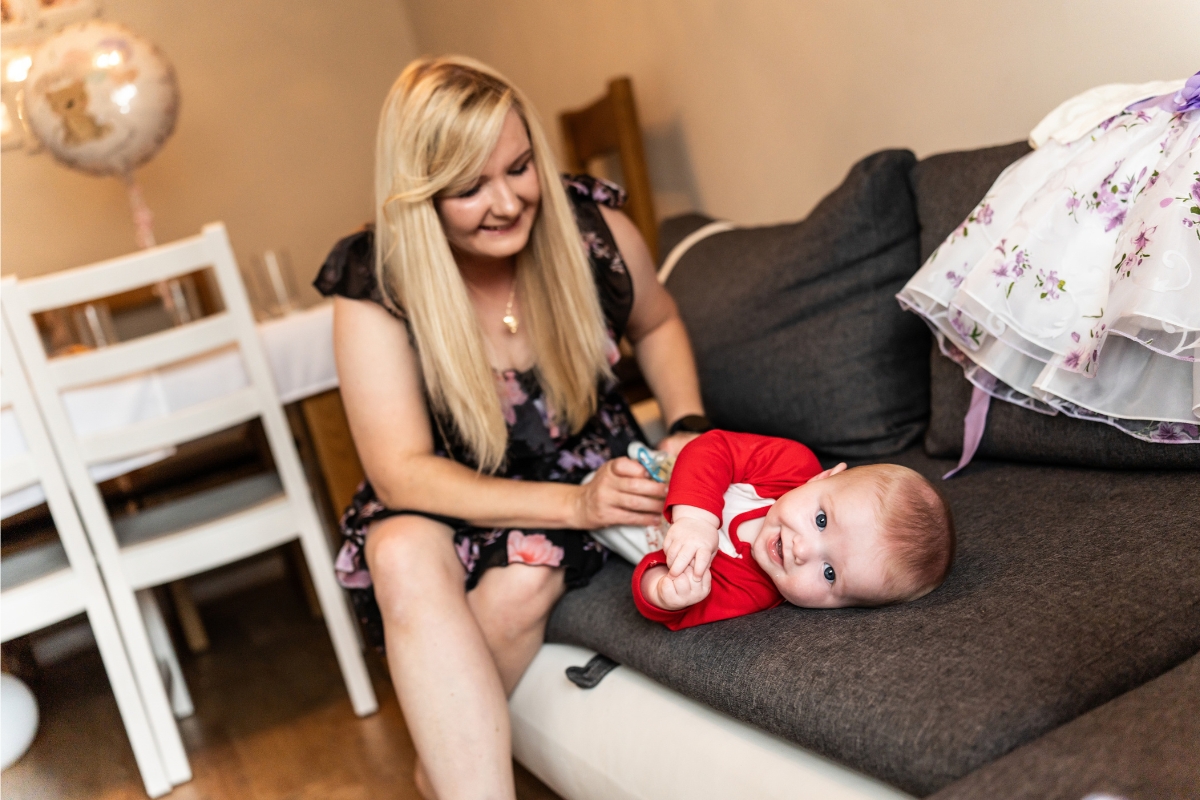
Karolina Gudes is the founder of Kidora, a UK family platform for buying, selling and passing on children’s items. She is a mum of two from North Wales and one of Theo Paphitis’ #SBS Small Business Sunday winners.
One of the hardest decisions I have made while building Kidora was not deciding to start the business. It was deciding to start the technology again after we had already launched.
Our first version of Kidora went live in May 2025. We built it on WordPress with a webview-style app because we wanted to get the idea into the hands of parents without spending a huge amount of money. At the time, it felt like a practical way to begin.
But as we developed it, the weaknesses became harder to ignore. The website was slow, the setup had become heavy with plugins, and we were relying on third-party tools for too much of the functionality. The more we thought about growth, the more obvious the problem became. If the platform was already struggling at an early stage, what would happen if many more parents started using it?
My partner Martin and our colleague John both work in software quality assurance, and they explained the technical issues to me very clearly. Their view was that we could keep patching the existing platform, but every patch would make us more dependent on a foundation we no longer trusted.
I agreed with them straight away. I am not a developer, but I understood the business problem. If we wanted parents to trust Kidora, the platform itself had to be stable, fast and something we could keep building on.
The difficult part was knowing what that decision meant. Rebuilding would not take a few weeks. We expected it to take around 12 to 14 months of daily work, most of it fitted around our normal jobs and family life.
We chose to do it anyway.
Starting again was painful, but carrying on would have been worse
It is very easy to become attached to something because you have already spent money and time on it. We had launched the first platform. We had put work into it. Starting again meant accepting that much of that work would not become the long-term product.
There is always a temptation to say, “We have come this far, so let’s just keep improving what we have.” But if we knew this was not the platform we wanted to depend on when Kidora grew, why spend another year making it harder to replace?
So Martin and John started rebuilding the website in Laravel and creating the iOS and Android apps in Flutter. The aim was to give us much more control and allow us to build more of the functionality ourselves rather than depend on a large stack of third-party plugins.
That decision made the next year harder, but it also gave us a clearer direction. We were no longer trying to make the old platform behave like the product we wanted. We were building the product we actually wanted.
If I started again, I would not make the same technical choice
Looking back, I would not build the same WordPress version again.
That does not mean the first version taught us nothing. It showed us the reality of running the platform and helped us understand what we needed. But technically, it became a source of frustration very quickly, especially because of performance and plugin dependency.
If I were starting Kidora again tomorrow, I would begin with the approach we use now. I would still choose Laravel for the website because it gives us the flexibility to build quickly while keeping performance under our control, and I would build the mobile apps properly from the beginning.
Building a marketplace and family platform with a three-person team is difficult, but I would rather accept that from the start than spend months building something I know I will eventually need to replace.
Keeping our jobs was not a lack of commitment
Another decision that shaped Kidora was that none of us left our jobs to build it.
There are three of us behind the business: me, Martin and John. We have put roughly £7,000 of our own money into Kidora, we have taken no external investment, and none of us takes a salary from the company.
I still work in retail. Martin and John have continued their own full-time work while building and testing Kidora around it.
From the outside, people sometimes associate starting a serious business with quitting your job and going all in. Our experience has been different.
Keeping our jobs has helped protect the business. Kidora does not have to support three salaries while it is still growing, and we can make decisions based on what we think the platform needs rather than the quickest short-term return.
There is a cost to that choice, though, and the cost is time.
A lot of Kidora has been built in the evenings, late at night and at weekends. During the rebuild, Martin and John spent countless nights coding, testing and improving the platform after their normal working day.
Family life still has to be family life
For me, the hardest part is balancing all of this with being a mum to two young children.
I want to build Kidora seriously, but I also want to be present for my children. They still need normal family life, happy days out, routines and time with us that has nothing to do with a business.
That means the business often has to fit into the spaces around family life rather than taking over everything.
Some days that works well. Other days it means opening the laptop after the children are asleep when I am already tired.
The biggest lesson I would give another woman building a business alongside a job and children is not to expect perfect balance every day. You still need to be the best mum you can be, and you still need family time that feels like family time. At the same time, if the business matters to you, there will be periods when you have to find energy after everyone else has finished for the day.
For me, the important thing is knowing why I am doing it. Kidora came from a problem I experienced as a parent, and I am building it for families like mine. That makes the difficult evenings easier to understand.
Bootstrapping forces you to be more deliberate
Building with around £7,000 rather than a large investment has also changed the way we think.
We cannot solve every problem by paying someone else. We have to decide which features matter, what can wait, and whether something is worth the time it will take to build and support.
The rebuild is the clearest example. It would have been easier in the short term to keep adding plugins and small fixes to the original platform. Instead, we accepted a much bigger amount of work because we believed it would reduce our dependence on other systems and give us a stronger base.
Being bootstrapped has made us slower in some ways, but it has also made us think much harder about what we are building and why.
The lesson I keep coming back to
If there is one lesson I keep coming back to, it is that founders have to be willing to change direction even when the change makes previous work feel wasted.
The first version had taken time and money, so it would have been emotionally easier to defend it and keep going. But the work was not really wasted. It taught us what the platform needed to become, and it made the weaknesses impossible to ignore.
The mistake would have been knowing the foundation was wrong and continuing simply because we had already built it.
Today, I am much more comfortable with the idea that changing direction is not the same as failing. Sometimes the most responsible decision is the one that creates more work now but gives the business a better chance later.
I also no longer think commitment to a business has to be measured by how dramatically you change your life for it. We have kept our jobs, funded Kidora ourselves, raised our children and built around the hours we actually have.
It has been slower and harder than I imagined, but I would rather build something carefully and sustainably than rush because I feel I have to look like a full-time founder.
We are still building, still learning and still making mistakes. The difference now is that I am much quicker to ask whether something is genuinely helping us move forward, or whether we are only holding onto it because of the work already invested.
That question changed Kidora once already, and I suspect it will be one of the most useful questions I carry with me as the business grows.
Karolina rebuilt Kidora without quitting her job, on £7,000 of her own money. For the wider picture of mums building businesses around family life, and why women make great entrepreneurs, see our guides. If you are starting with nothing, our piece on businesses you can start with no money covers the options.