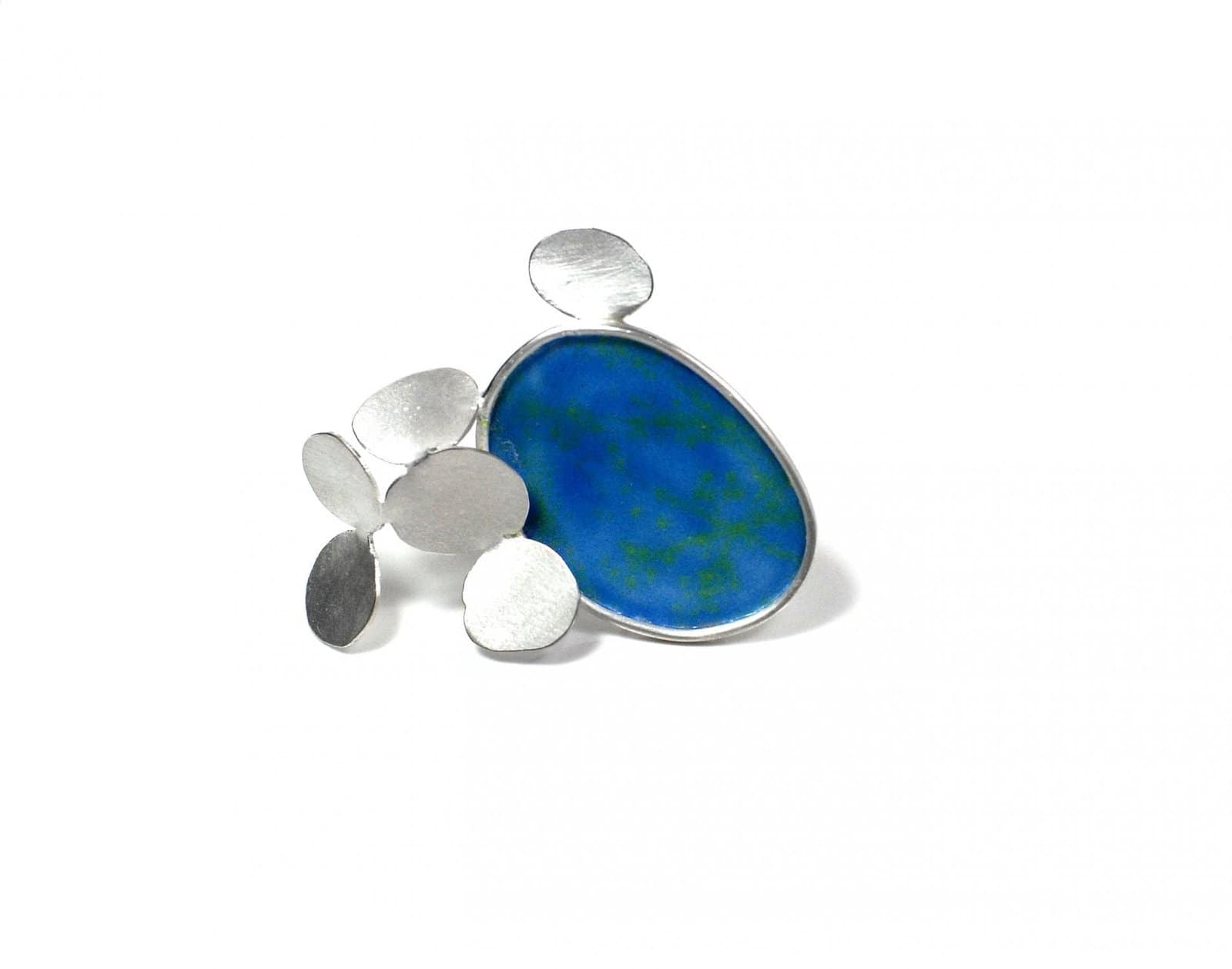
From wearable pieces to dramatic statement designs, Miranda Sharpe has spent more than two decades creating beautifully handcrafted jewellery. Her experience as a designer maker shows that creative self-employment is sustainable when you treat the business side with the same care as the craft itself.
Being self-employed gives Miranda the freedom to decide what she makes and how she develops her collections. Yet that freedom comes with responsibility. A designer maker is simultaneously the designer, maker, administrator, marketer, sales representative, buyer and bookkeeper. Miranda’s advice is to accept that breadth of role, stay aware of market shifts and remain adaptable.
My job is an amalgamation of all the roles you might find within a company. I am the designer, the maker, the administrator, the promoter, the sales rep, I order the materials and manage the books.
According to the Crafts Council’s Measuring the Craft Economy report, published in 2024, the UK craft economy generated an estimated £3.4 billion in 2022 and supported around 149,000 jobs. Designer makers form a large part of that ecosystem, selling through galleries, contemporary craft fairs, their own websites and online marketplaces. The wider creative industries contributed £126 billion in gross value added to the UK economy in 2022, according to DCMS economic estimates published in 2024, underlining the commercial weight of creative work.
For Miranda, the most rewarding part is earning an income from work she loves; the challenge is that income can be uneven and sensitive to the wider economy. Her response is to keep evaluating her range, her pricing and her routes to market. Trade and retail shows remain an important way to reach galleries, boutiques and direct customers, while a professional website, social media and listings on craft marketplaces are now essential rather than optional. Miranda uses a mix of these channels to maintain visibility between shows.
Finding focus in the early years
After completing an MA at the Birmingham School of Jewellery, Miranda joined a business incubation scheme in Birmingham’s Jewellery Quarter. Incubators and creative workspaces offer early-stage makers more than desk space: they provide structured business support, peer networks and shared equipment that reduce start-up costs.
Being part of the scheme focused my ideas and enabled me to put a business focus on how to begin earning a living from making contemporary jewellery. I also met others in the same position who I then set up a workshop with. Being part of a group meant I had others to bounce ideas off and we could test out potential shows together to reduce the initial costs.
Today, makers can access similar support through business grants for women in the UK, local Growth Hubs, the Crafts Council’s business development programmes, university enterprise services and sector networks such as Design-Nation and Making It. Many women-led businesses also benefit from mentoring through programmes aimed at women in business. If you are registering as self-employed for the first time, our self-employed tax UK guide for 2026/27 sets out the current thresholds and deadlines.
Making the most of my time
As an established designer who exhibits and sells internationally, Miranda works from home and balances family life with her business. The secret, she says, is discipline. Creating a workspace that is physically separate from the rest of the house helps her switch into work mode and close the door at the end of the day.
Since having a family I have had to work within specific time frames, so I find that I have to be more focused and efficient. Working from home allows me to make better use of the time I have available as I don’t have to incorporate travel time into my day. However, I do tend to use my evenings to make up my working hours instead of getting the chance to put my feet up and watch some TV.
Time management is a common issue for home-based makers. Cloud accounting, scheduling apps and batch production can protect making time. Setting clear boundaries with family and clients also helps prevent the working day from stretching indefinitely. If you run your studio from home, our guide to home working expenses self-employed people can claim through HMRC explains what you can offset against tax.
Miranda’s tips for a new designer maker
- You need to be motivated, passionate, resilient and have a clear idea about where you want to sit in the marketplace.
- Research and test your ideas. What are you offering? Who is it for? Do they want it, and how will you reach them?
- It can take time to get things off the ground, so plan how you will support yourself financially in the meantime. Persistence matters.
- Your product will not be right for everyone. Don’t take rejection personally; keep approaching potential customers to find the right fit, listen to feedback and be prepared to adapt.
- Keep your costs visible. Price for materials, time, overheads and profit from the start so you do not undercut your own sustainability.
- Build a support network of peers, mentors and business advisers. Running a maker business is easier when you are not completely on your own.
Where to sell contemporary craft in the UK
- Contemporary craft fairs such as those organised by the Crafts Council, Handmade in Britain and local arts markets.
- Galleries and boutiques that specialise in designer-maker work, often found in creative quarters such as Birmingham’s Jewellery Quarter, Cockpit Arts in London and regional craft centres.
- Online marketplaces including Etsy, Folksy and Not On The High Street, plus your own e-commerce website.
- Social media and email marketing for storytelling, building a following and driving traffic to your shop.
Action steps for aspiring designer makers
If you are a woman founder thinking of turning a craft practice into a designer maker business, start by mapping your skills, your ideal customer and your first route to market. Check whether you qualify for local Growth Hub support or a women-focused grant, register for self-assessment if you are working for yourself, and set up a simple system for tracking income and expenses from day one. For practical guidance on pricing, marketing and the current UK rules for self-employed makers, see our women in business key UK facts page and our allowable expenses self-employed UK guide.