Prowess’s 2007 research found that women founders in SET were more innovative than their male counterparts. Women-led businesses were more likely to bring a product new to market, more likely to embed technology in their products or services, and more likely to have developed their offer within the last year. Yet the number of women-owned companies in Science, Engineering, Construction and Technology, often shortened to SET or SECT, remains disproportionately small. This article examines where women in SET enterprise stand in 2026, what has changed since Prowess first investigated the sector, and what support still matters.
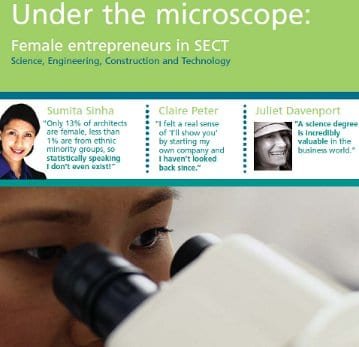
In 2007, Prowess carried out the first national survey of women running businesses in these high-growth sectors, commissioned by the UK Resource Centre for Women in Science, Engineering and Technology (UKRC). The resulting report, Under the Microscope: Female Entrepreneurs in Science, Engineering, Construction and Technology, examined the motivations, barriers and support needs of women in SET enterprise. It remains a landmark piece of Prowess research.
The UKRC closed in 2012, and the original 2007 report is now archived. Its central findings are still relevant: women in SET enterprise were highly qualified, often driven by a desire for autonomy and flexibility, but frequently overlooked by mainstream business support, finance providers and sector networks. Many reported that gendered assumptions about technical sectors made it harder to win customers, access capital and find mentors who understood their industries.
How the landscape has changed for women
The policy conversation has moved on. The 2019 Alison Rose Review of Female Entrepreneurship found that only around one in three UK entrepreneurs is a woman, and that closing the gender entrepreneurship gap could add up to £250 billion to the economy. Subsequent Rose Review progress reports have tracked a gradual rise in the number of women-founded businesses, but the gap remains significant.
In STEM specifically, the picture is mixed. According to the WISE Campaign, women made up 29% of the UK STEM workforce in 2023, with particularly low representation in engineering, construction and ICT. EngineeringUK’s 2024 report found that women represent just 16.5% of the engineering workforce. Self-employment and company ownership in these sectors are even less balanced. Data from the Office for National Statistics and business information providers show that women remain underrepresented among founders of high-growth technology and engineering ventures, although the proportion of high-growth companies with at least one women founder has risen in recent years.
Several initiatives now target this gap. The Investing in Women Code asks financial institutions to improve data collection and support for women entrepreneurs. Innovate UK‘s Women in Innovation programme has provided funding, mentoring and networking opportunities for women-led innovative businesses, with over £50 million awarded to women founders since its launch in 2016. Sector bodies such as WISE, STEM Returners and women-in-tech networks have expanded mentoring, returner programmes and visibility campaigns. The Women Backing Women Fund, a £130 million investment vehicle launched in 2024, has also begun deploying capital specifically to back women founders.
Persistent barriers for women in SET enterprise
Despite these advances, many of the barriers identified in the 2007 Under the Microscope report are still visible today:
- Access to finance: Women founders still raise far less equity investment than male founders. The British Business Bank’s Small Business Equity Tracker 2024 shows that all-female founder teams received only around 2% of UK equity investment, while all-male teams received roughly 85%. You can read more about this in our VC funding gap for women founders analysis.
- Networks and visibility: Women in SET often report feeling isolated in male-dominated sectors and lacking access to the informal networks that generate referrals, partnerships and investment leads.
- Sector stereotypes: Cultural assumptions about who belongs in science, engineering, construction or technology continue to influence customers, suppliers, educators and investors.
- Work-life balance and caring responsibilities: Self-employment can offer flexibility, but unpredictable income and a lack of maternity or parental benefits can make it harder for women to sustain a business through key life stages.
- Procurement and supply chains: Women-led SET businesses can struggle to break into corporate and public-sector supply chains, where tender processes and relationship-based contracting favour established players.
Why SET enterprise matters
Science, engineering, construction and technology are among the UK’s highest-productivity sectors. They attract innovation funding, export opportunities and policy attention. If women are underrepresented as founders, the economy loses not only potential turnover and jobs but also diverse perspectives on product design, customer needs and technological risk.
The 2007 Under the Microscope report was a milestone because it proved that women in these sectors were not a niche curiosity but a significant, under-supported entrepreneurial population. Today, the challenge is to turn that recognition into practical, sustained support. You can explore more of our resources, including guidance on women in tech jobs, to find advice relevant to your sector.
Support that women in SET need
Based on the original findings and more recent evidence, effective support for women in SET enterprise should include:
- Finance designed for women founders: More women decision-makers in investment, transparent diversity data, and funds that understand the sectors women are building in. The British Business Bank’s new funding rules for women founders are one step in this direction.
- Technical and business mentoring: Mentors who combine sector expertise with entrepreneurial experience, delivered through peer networks and structured programmes.
- Procurement access: Clearer routes into public and private supply chains, including supplier diversity programmes and broken-down contracts that suit growing businesses.
- Childcare and caring infrastructure: Affordable, flexible childcare and recognition of caring responsibilities in business support design.
- Visible role models: Case studies, media coverage and events that show women successfully leading science, engineering, construction and technology firms.
The future for women in SET enterprise
The Under the Microscope research remains a valuable benchmark for understanding women in SET enterprise. While the UK has made progress on women-led enterprise overall, women in science, engineering, construction and technology still face a distinctive set of barriers. Closing the gap will require targeted finance, inclusive networks, procurement reform and a culture that expects women to lead in technical sectors. Prowess continues to champion women-led enterprise and to highlight the data, stories and policies that can make the UK’s SET economy more representative and more innovative.