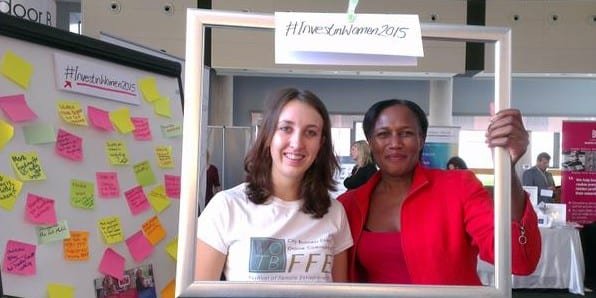
In 2014, Prowess Connect took the Manifesto for Women in Business to the Festival of Female Entrepreneurs in Bristol to ask women founders what support they actually needed. More than a decade later, the same five themes dominate the agenda for anyone trying to support women in business: fair funding, flexible systems, care infrastructure, enterprise education and the confidence to scale. The Women in Business: Key UK Facts page shows why these issues still matter in 2026.
Prowess Connect is an informal network of people committed to practical change for women in business. Through our work with founders, advisers and policymakers, five challenges keep surfacing, especially for women with caring responsibilities. They shaped the Manifesto for Women in Business, which sets out where government, investors and business support organisations can do more to ensure women are funded, heard and represented.
What Bristol women in business told us in 2014
The Festival of Female Entrepreneurs brought hundreds of women to Bristol for what was then the UK’s largest female entrepreneur festival. Joni Farthing, the festival’s founder and a vocal advocate for investment in women-led businesses, gave Prowess Connect a stall to talk to delegates about the Manifesto. The conversations we had that day still resonate.
The original 2014 tweet embeds are no longer available, but the messages remain. Delegates queued to share their priorities, and the same issues came up again and again. Their message was consistent: they needed funding that understood their lives, not just their balance sheets, and flexibility that let them care without giving up growth.
Flexibility and care were the most talked-about obstacles. Women spoke about caring not only for young children but for older relatives, teenagers and family members with additional needs. The “sandwich generation”, those juggling parents and children, was already visible in 2014 and has only grown since.
Education came up repeatedly. Delegates wanted enterprise skills, financial literacy and business thinking introduced earlier, so that girls and young women see entrepreneurship as a realistic path rather than something that happens only to people with existing connections or capital.
Funding and business support were also high on the list. Women reported struggling to find clear information about finance and said support services often felt generic rather than tailored to women’s lives, sectors and business models.
Thinking bigger was another recurring theme. Several attendees said women need encouragement to start and scale businesses, not just become self-employed. That is why the Manifesto’s call for fair access to growth investment remains so important.
Why these priorities still matter in 2026
The UK has made some progress since 2014, but the headline figures show how much remains to be done. The Rose Review Female Entrepreneurship: Progress or Promises? notes that the proportion of UK companies led by women rose from 16% in 2018 to 20% in 2023, according to the Alison Rose Review of Female Entrepreneurship Progress Report 2024. While that is welcome, it still means men lead four out of five UK businesses. If women started and scaled businesses at the same rate as men, the economy could gain up to £250 billion, the Rose Review estimates.
The funding gap is particularly stubborn. Beauhurst data from 2024 shows that all-female founder teams still receive only around 2% of UK equity investment, and the Rose Review found that women typically start with roughly half the capital of their male counterparts. Women are also less likely to apply for bank lending or feel confident navigating grant and investor networks. Business support that is not designed around caring responsibilities, confidence and access to networks often misses the women who need it most.
Flexible working has moved up the political agenda. Employees now have a day-one right to request flexible working under the Employment Relations (Flexible Working) Act 2023, which took effect in April 2024, as ACAS guidance confirms. That helps employed women, but founders and the self-employed still have to build flexibility into their own business models without statutory backing. ONS data from 2024 puts the number of self-employed women in the UK at around 1.6 million, many of whom are juggling business with care.
Affordable, accessible childcare and adult social care remain major barriers. The government’s 30 hours free childcare offer for working parents of children from nine months old rolled out fully in England in September 2025, according to gov.uk, but self-employed women often struggle to meet the earnings threshold and many report patchy local availability.
Here are five ways to support women in business
The Manifesto translates these challenges into five practical priorities. Here is what they mean in 2026.
1. Fund women founders fairly
Fair funding means more than goodwill. It requires investment products, decision-making panels and due diligence processes that recognise women’s business models, sectors and caring responsibilities. The British Business Bank has expanded its support for women-founded businesses, including the £130 million Women Backing Women Fund, while schemes such as the British Business Bank’s Start Up Loans remain a critical source of early finance. Yet Beauhurst data from 2024 shows that all-female teams still attract only around 2% of UK equity investment.
2. Build flexibility and care infrastructure
Women cannot grow businesses if the care economy is broken. The day-one right to request flexible working is a step forward for employees, but self-employed women need affordable childcare, adult social care and school-hour support that fits irregular income. The Free Childcare Self Employed UK guide explains how the 30-hour offer works for self-employed parents. Without reliable care infrastructure, women continue to start smaller, borrow less and scale more slowly.
3. Teach enterprise skills earlier and wider
Enterprise education should start before university. Girls need exposure to finance, negotiation, business planning and digital skills, delivered by relatable role models. The Manifesto calls for enterprise skills to be embedded in schools, colleges and careers advice, with explicit outreach to young women from backgrounds where entrepreneurship is rarely discussed.
4. Tailor business support to women’s lives
Generic advice does not work when your working day is shaped by school runs, caring duties or menopause symptoms. Women need mentors, networks and programmes that understand these realities. The Women in Business Networks UK communities offer peer support, and the Business Grants For Women in UK page lists current funding opportunities. Support should also signpost practical guidance such as the Making Tax Digital Sole Trader: 2026 Checklist for Women.
5. Back women to scale, not just start
Too much policy focuses on getting women into self-employment and too little on helping them build teams, turnover and equity value. Women founders need growth capital, procurement opportunities, board introductions and export support. The Pitch Deck Guide for Female Founders UK is one practical resource, while the Mansion House SME Finance reforms aim to improve access to growth finance for smaller firms.
What you can do now
The Manifesto is not a historical document. It is a living set of priorities that gains strength every time a woman in business adds her voice.
Read and share the Manifesto
Share it with your networks, your local business group or your MP, and explain which point matters most to you.
Lobby your MP for concrete commitments
Email your MP and ask what their party is doing for women in business. Attach the Manifesto and ask for specific commitments on funding, childcare, flexible working or enterprise education. You can find your MP’s contact details on the UK Parliament website.
Join Prowess Connect and add your voice
Sign up to Prowess Connect and join the conversation on LinkedIn. Help shape the next steps for the Manifesto and connect with others who are campaigning for change.
Pledge your support on the Manifesto page
Leave a comment on the Manifesto page to show that women in business are a constituency that policymakers cannot ignore.
Spread the word through your networks
If you work with a Chamber of Commerce, local council, networking group, investor network or business school, tell them about the Manifesto and encourage them to adopt its recommendations.
Join the movement for women founders
The women who stopped at the Prowess stall in Bristol in 2014 made one thing clear: they wanted practical change, not warm words. Today, women founders across the UK are still asking for the same things: fair funding, flexible systems, better care infrastructure, enterprise education and the confidence to scale.
By speaking up, sharing the Manifesto and holding decision-makers to account, you can help turn those conversations into policy. Add your voice to the movement to support women in business today.
Helen Farmer and Yvonne Bignall are members of Prowess Connect and run their own businesses. They continue to campaign for better support, funding and representation for women in business.