The moment women’s business support disappeared from GOV.UK
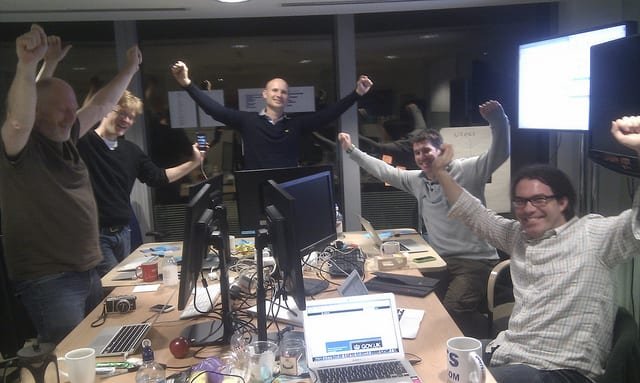
In October 2012, the Business Link website was switched off and replaced by the new GOV.UK platform. At the time, Prowess warned that the change risked erasing targeted support for women entrepreneurs, disabled business owners and social enterprises from mainstream government information. A celebratory team photo posted by the Government Digital Service (GDS) — an all-male group of developers — seemed to capture the problem in a single image: the people redesigning public business support did not look like the diverse population they were meant to serve.
The philosophy behind GOV.UK was clear: strip away clutter, focus on task completion, and help users do what they needed quickly. For some entrepreneurs, that transactional approach works well. But starting and growing a business is also a learning journey. The old Business Link site had its flaws, yet it was widely used as a curated library of guidance, signposting and sector-specific routes. When it closed, much of that nuance was lost.
There is targeted information for women in business on the BL site. Can you confirm that this will also be the case with gov.uk? With women now comprising over half of those registering self-employed, and presenting often very different experience and aspirations, I believe it is more important than ever.
We did not receive a response. More than a decade later, the question remains relevant.
Why a purely transactional model falls short
The GDS team, led by Mike Bracken, argued that government websites should be judged on whether users can complete a task quickly and simply. That principle transformed many public services for the better. In business support terms, however, it assumed that most entrepreneurs already know what they need.
For many women starting a business, that is not the experience. Research consistently shows that women are more likely to launch ventures with lower start-up capital, smaller networks and greater caring responsibilities. They are also more likely to value peer support, mentoring and signposting alongside finance. A website that treats every visitor as a fully informed applicant will inevitably underserve founders who are still building confidence and mapping their options.
What has changed since 2012?
The UK enterprise landscape has shifted significantly. Women-led businesses are now recognised as one of the most important untapped sources of economic growth. The 2019 Alison Rose Review of Female Entrepreneurship found that if women started and scaled businesses at the same rate as men, up to £250 billion could be added to the economy. By 2023, women-led businesses accounted for around one in five UK businesses and contributed an estimated £85 billion to economic output.
Government support has also evolved. The Start Up Loans programme, delivered by the British Business Bank, has provided more than 100,000 loans, with around two in five going to women. The Women in Enterprise Action Plan sets out commitments on finance, mentoring and childcare, while the Investing in Women Code asks financial institutions to improve data and access for female founders. Regional support is now channelled through mayoral combined authorities, local councils and growth hubs rather than the old Business Link network.
Has the one-size-fits-all problem been solved?
Despite this progress, the underlying design tension remains. GOV.UK still prioritises simplicity and task completion. That is excellent for someone who knows exactly which form to file, but less helpful for an aspiring entrepreneur who needs to understand what support is available, how to build confidence, or which networks to join. For women, who often start businesses with fewer external contacts and less available capital, a purely transactional site can leave important questions unanswered.
When Business Link closed, pages covering equality and diversity policies, disability support and social enterprise were either removed or reduced to bare legal summaries. Today, information on these topics is scattered across GOV.UK, third-sector organisations and local providers. A founder searching for women’s business support may find the main government site points her towards generic start-up guidance rather than tailored mentoring, funding or networks.
Persistent gaps in 2025
Several barriers are still familiar. Access to finance remains the most frequently cited obstacle: all-female founder teams still receive only a small fraction of UK equity investment, and women are more likely to rely on personal savings or smaller loans. Childcare costs continue to shape how — and whether — women can commit to a new venture. Underrepresentation in high-growth sectors such as technology and venture capital means that female founders often lack visible role models and warm introductions to investors.
Regional inequality also matters. Women in London and the South East typically have more access to finance, networks and accelerators than those in the Midlands, the North, or rural areas. Without a national, easily navigable source of information, these disparities can widen.
What good support should look like
The lesson of 2012 is that diversity is not a niche issue. When government business support is designed around a single “typical” entrepreneur, it excludes the very people who could contribute most to growth. Good support should:
- Signpost targeted funding, mentoring and networks for women, disabled entrepreneurs, ethnic minority founders and social enterprises from the main GOV.UK business pages.
- Recognise that starting a business involves learning and confidence-building, not just form-filling.
- Collect and publish disaggregated data so gaps in access and outcomes are visible.
- Co-design services with diverse users, not just for them.
Looking ahead
GOV.UK has matured since its launch, and there is now more policy attention on women’s enterprise than ever before. Yet the warning Prowess issued in 2012 still resonates. Closing Business Link removed a trusted gateway; replacing it with a streamlined but generic portal left many founders to hunt for support elsewhere. As self-employment and entrepreneurship continue to grow, government must ensure that its digital front door opens as easily for women, disabled people and underrepresented groups as it does for everyone else.
Prowess continues to champion women in business and to call for support that reflects the real diversity of UK entrepreneurship. If you are looking for practical guidance, explore our resources for women entrepreneurs or connect with a women’s enterprise network in your area.