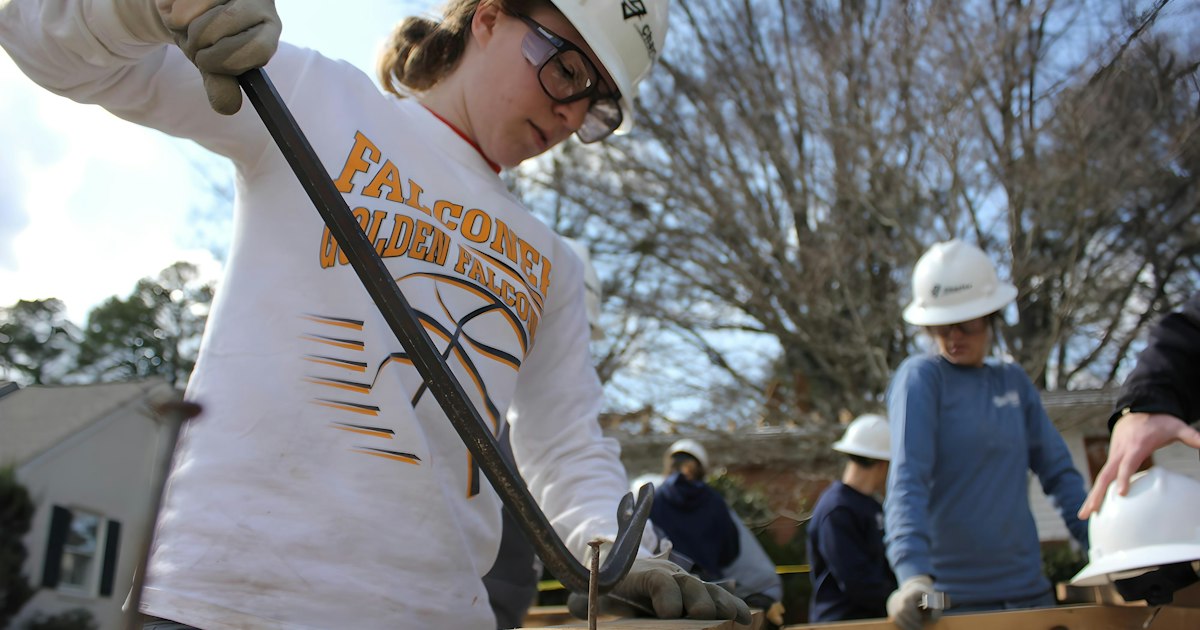
When this Nottingham building surveyor left school, she followed a path that still works in 2026: she turned a love of technical drawing into a chartered career in the built environment. Her story shows that becoming a female surveyor is not about fitting an old stereotype. It is about combining technical judgement, project management, and the freedom to shape your own working day.
At school, she always had an interest in technical drawing. A careers adviser suggested building surveying rather than architecture, and the appeal was immediate: refurbishments where she could see her work making a difference. After GCSEs she took a diploma in Building Studies at her local college, then a degree in Building Surveying at the University of Salford. She now works as a building surveyor for the University of Nottingham, project managing work on halls of residence, managing a budget of around £1 million, writing specifications, looking after engineers and taking responsibility for the full delivery.
The best part of the job, she says, is the variety. She can plan her day and manage her workload as she sees fit. She is always on the move, so the work never feels repetitive.
Why construction still needs women surveyors in 2026
The UK construction sector remains one of the least gender-balanced parts of the economy. According to ONS data from 2024, women made up around 15.9% of the construction workforce. For more context on women in the UK economy, see our Women in Business: Key UK Facts page. Within the surveying profession, representation is higher but progress is still uneven. The Royal Institution of Chartered Surveyors (RICS) continues to report that women are under-represented in senior surveying roles, which makes visible career stories particularly valuable.
Demand is also strong. The Construction Industry Training Board (CITB) forecasts that the UK will need an additional 251,500 construction workers between 2024 and 2028 to meet current project pipelines. Building surveyors are in demand across retrofit, conservation, and public estate management.
For women considering a career change or a return to work, this creates a genuine opening. Surveying rewards people who can manage detail, communicate across teams, and solve problems on site. Those skills transfer from many other sectors. If you are weighing a move at 40 or beyond, our guide to Career Change at 40: A Practical Guide for Women sets out how to map your existing experience onto a new profession.
What a building surveyor actually does
Building surveyors advise on the design, construction, maintenance, repair, and refurbishment of residential, commercial, and public buildings. On a typical day you might inspect a roof, negotiate a repair schedule, prepare a specification for contractors, manage a £500,000 refurbishment budget, or advise a client on compliance with building regulations.
The role is broader than many people realise. It is not only about hard hats and site visits. Specialisms include project management, building pathology, conservation of historic buildings, party wall matters, dilapidations, and sustainability advice. That breadth is one reason the profession suits people who want variety and autonomy.
Routes into becoming a female surveyor in 2026
You no longer need to follow one fixed path. In 2026 the main routes into building surveying are:
- University degree: An accredited BSc or MSc in Building Surveying, followed by the RICS Assessment of Professional Competence (APC). The APC typically takes two years of structured training after your degree. The University of Salford, Nottingham Trent University, and many other UK institutions offer RICS-accredited courses.
- Degree apprenticeship: A Level 6 Building Surveyor Apprenticeship lets you earn while you study and avoids tuition fees. Employers including local authorities, housing associations, and consultancies advertise these through the government’s Find an Apprenticeship service.
- Technical route: Some surveyors start as surveying technicians and progress to chartered status through work-based assessment.
According to the National Careers Service in 2026, starting salaries for building surveyors are typically £25,000 to £35,000. Experienced chartered surveyors can earn £45,000 to £70,000 or more, with senior roles in London and the South East at the top of the range.
Professional bodies and support networks
The Royal Institution of Chartered Surveyors (RICS) is the main professional body for chartered surveyors in the UK. Membership gives you access to standards, training, and the APC route to chartered status. The RICS Matrics network supports younger members and those new to the profession.
Beyond RICS, several UK networks exist specifically for women in property and construction:
- Women in Property: Runs regional events, mentoring, and awards for women working in property and construction.
- Women in Construction: Campaigns to improve recruitment, retention, and progression for women in the industry.
- Local RICS committees and Matrics groups: Often host site visits and CPD sessions that are open to non-members.
For broader connections, see our guide to Women in Business Networks UK: The Best Communities to Join in 2026.
Practical steps if you are considering surveying
- Check your qualifications. Most accredited degrees ask for relevant A Levels or equivalent. If you do not have these, an access course or HNC in construction can be a stepping stone.
- Shadow a surveyor. Contact local surveying firms or council building control teams and ask for a half-day observation. Most professionals are happy to talk about their work.
- Explore apprenticeships. Search “building surveyor apprenticeship” on the government’s Find an Apprenticeship service to see current vacancies in your area.
- Join a network early. You do not need to be qualified to attend many Women in Property or RICS Matrics events.
- Plan your APC. If you choose the degree route, start thinking about your Assessment of Professional Competence before you graduate. The right employer will support you through it.
Conclusion
Becoming a female surveyor in 2026 is a realistic, well-paid option for women who want technical work without being tied to a desk. The Nottingham case study shows that a clear route, from technical drawing at school to chartered building surveyor, is still open. With construction facing a long-term skills shortage and employers under pressure to diversify, women who bring transferable skills and a willingness to learn are in a strong position. Start with one conversation, one site visit, or one apprenticeship application, and build from there.
First published on the Know Your Place website. Updated for Prowess in 2026 with current UK routes, salaries, and professional resources.