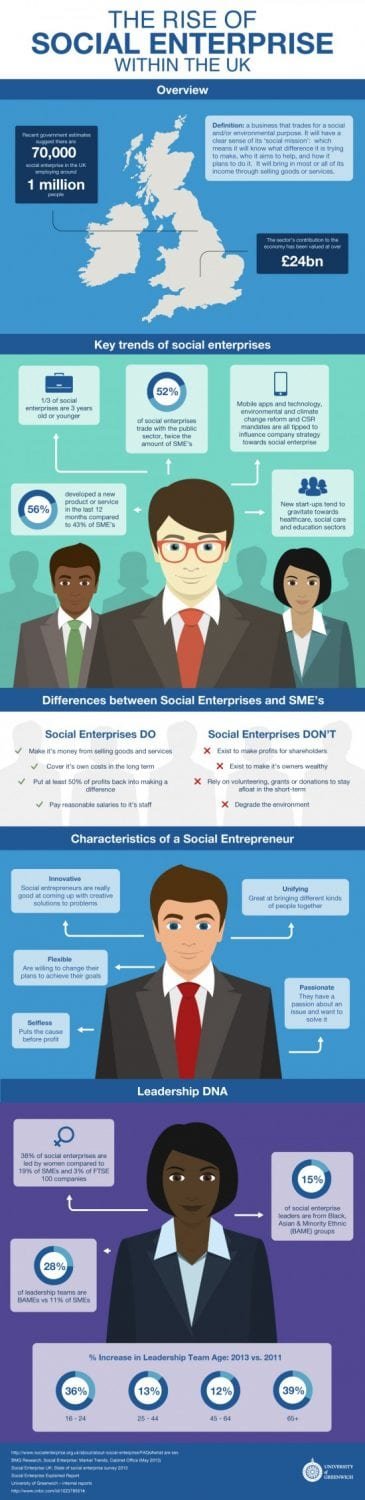
Social enterprise in the UK is now a mainstream part of the economy. A social enterprise trades for a social or environmental purpose and reinvests the majority of its profits towards that mission. Women-led social enterprises UK are a growing force within this sector. According to Social Enterprise UK’s State of Social Enterprise 2023, the most recent comprehensive sector survey, there are around 131,000 social enterprises in the UK, contributing an estimated £78.7 billion to the economy and employing roughly 2.3 million people. The sector also has a strong start-up culture: around one in five social enterprises is less than three years old, roughly double the rate seen among traditional SMEs. For women who want to build a business around purpose as well as profit, social enterprise offers one of the most accessible routes to ownership in the UK.
Women-led social enterprises UK lead from the front
One of the most striking features of the sector is the proportion of women in leadership roles. More than half of UK social enterprises, 52%, have a majority-female board, compared with just 18% of SMEs. This is all the more notable when set against the mainstream corporate world. The FTSE Women Leaders Review 2025 found that women now hold 42% of FTSE 350 board seats, yet women remain under-represented at the very top: fewer than one in ten FTSE 100 CEOs is a woman.
The difference is not simply about boardroom numbers. Social enterprises are more likely to be founded and run by women who want to combine commercial acumen with a clear social or environmental purpose. For many, the sector offers an alternative to a traditional business culture that can still feel exclusionary at the most senior levels, and it provides a route to ownership that does not depend on climbing a conventional corporate ladder. You can see the broader picture in our Women in Business: Key UK Facts page.
Diversity goes beyond gender in the sector
The leadership profile of social enterprises is also more diverse in other respects. Around 14% are led by people from Black, Asian and minority ethnic backgrounds, compared with 6% of SMEs, and ethnic minority directors are more likely to sit on social enterprise boards. This reflects the sector’s deep roots in the communities it serves, including some of the most deprived areas of the country.
That community connection matters. A significant number of social enterprises are launched to improve local services, create jobs in disadvantaged areas, or address inequalities their founders have experienced directly. When a business is built around lived experience, its leadership team often looks far more like the community it serves than the board of a typical company.
Why social enterprise attracts women leaders
Several interconnected factors help explain why women are so strongly represented at the top of social enterprises.
- Mission-driven motivation. Many social enterprises are set up to tackle issues their founders have experienced first hand, from poor local services to barriers facing disadvantaged groups. That sense of purpose often appeals to women who want their work to reflect their values.
- Community accountability. Social enterprises typically embed community representation into their governance, whether through community shares, user-led boards or local partnerships. This can create leadership pathways for people who are under-represented elsewhere.
- Inclusive employment. A large number of social enterprises deliberately recruit people who face barriers in the labour market, including long-term unemployed people, disabled people, care leavers and ex-offenders. A values-led approach to staffing tends to be matched by more diverse boards.
- Reinvestment, not extraction. Because profits are reinvested into social or environmental aims rather than maximised for shareholders, the model can feel more aligned with long-term community wellbeing than with short-term financial returns.
- Flexible, entrepreneurial structures. Social enterprises often operate as community interest companies, co-operatives or mutuals, offering governance models that can be more flexible and collaborative than conventional corporate hierarchies.
Together, these characteristics create an environment in which women’s leadership is not an exception but an expectation. The sector’s success stories range from local food co-operatives and community energy schemes to national businesses tackling homelessness, mental health and environmental damage.
Challenges remain for women-led social enterprises
Despite these strengths, women-led social enterprises still face significant obstacles. Access to finance remains a persistent barrier. Female founders consistently raise less equity and debt than their male counterparts, and social enterprises can find it even harder to secure investment because their returns are measured in social as well as financial terms. Our Female Founder VC Funding Gap guide explores this in more detail.
Care responsibilities, complex public sector procurement processes and the technical language of social investment can also weigh more heavily on women leaders. Many social enterprises rely on public sector contracts, so cuts to local authority budgets and lengthy tendering processes directly affect their ability to grow and create jobs.
That makes targeted support essential. Organisations such as Social Enterprise UK and GOV.UK’s social enterprise guidance provide practical advice, while networks focused on women entrepreneurs offer mentoring, funding signposting and peer support. For funding options, see our Business Grants For Women in UK guide.
The future for women-led social enterprises
Women-led social enterprises UK are one of the few areas of the economy where women are not just present but leading in large numbers. As the sector grows, maintaining that inclusive leadership culture will be vital. For women considering entrepreneurship with purpose, social enterprise offers a proven, values-driven route to ownership and influence.
Action steps for women social entrepreneurs
- Read the latest Social Enterprise UK research to understand sector trends and benchmarks.
- Check whether your business model fits the GOV.UK social enterprise definition and explore Community Interest Company structures.
- Review our Business Grants For Women in UK and Start Up Loans Female Founders pages for funding routes.
- Connect with a women founders’ network or social enterprise hub in your region for peer support and procurement advice.
Since 2001, Prowess has supported women in business across the UK. Explore our resources for women entrepreneurs to find guidance on starting, funding and growing your venture.