Promoted to team lead? Moving into management? Stepping up to leadership? Congratulations. For women in business leadership, this transition is one of the most consequential career moves you can make, yet it is also one of the least prepared for. According to the Women in Business: Key UK Facts page, progress at the top is visible but uneven. The FTSE Women Leaders Review 2025 found that women hold 42.1% of FTSE 350 board seats and 96% of FTSE 350 companies have at least one woman on the board. Yet women still account for only around 30% of FTSE 350 executive committee members, and just 11 women lead FTSE 100 companies. The Alison Rose Review of Female Entrepreneurship (2019) found that only one in three UK entrepreneurs is a woman. The pipeline from expert to senior leader is still leaky.
Having risen on the strength of your technical expertise, the shift to manager and then leader can feel disorienting. The rules change. The skills that made you a star become secondary to organisational awareness, relationship management and communication. This is the Peter Principle in action: people are often promoted because they are good at their current job, not because they are ready for the next one. The result is that talented experts can end up struggling in roles that demand an entirely different expertise. The good news is that leadership can be learned, and with the right support, you can thrive.
From solo expert to collaborative leader
Today’s UK economy is driven by knowledge work and cross-functional collaboration, not by repeatable industrial processes. Whether you work in technology, finance, healthcare, marketing or professional services, your job as a leader is to combine, focus and direct the expertise of others towards a shared goal. That requires a deliberate mental shift.
As you move from expert to manager to leader, your vantage point changes. You are no longer paid for what you can personally produce; you are paid for what your team, department or organisation can achieve. The most effective leaders know when to operate as a manager, when to operate as a leader, and when to step back into expert mode briefly without taking over.
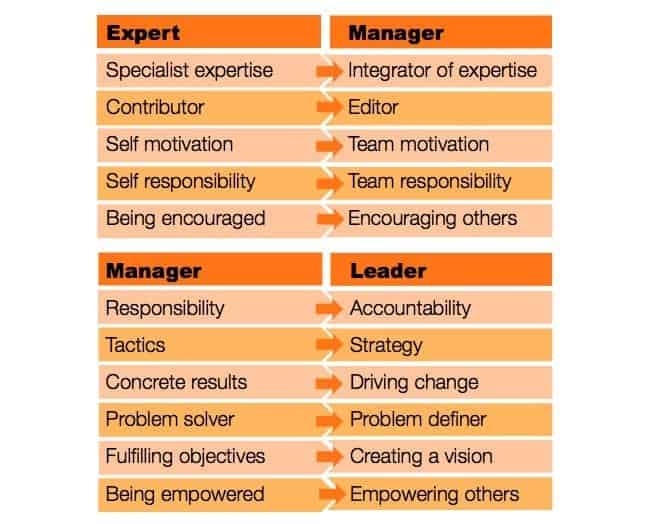
Key shifts in focus and behaviour include:
- From problem solver to problem framer. Experts are rewarded for finding answers. Leaders are rewarded for asking the right questions and defining the problem the team should solve.
- From individual accountability to collective accountability. Your success is now measured through the performance, development and wellbeing of others.
- From technical depth to strategic breadth. You need enough understanding across functions to make good decisions, rather than deep mastery of one specialism.
- From doing to enabling. Your role is to remove obstacles, secure resources and create the conditions in which others can do their best work.
- From being right to influencing outcomes. Leadership is less about having the best idea and more about building alignment around the best idea.
Women can bring particular strengths to this collaborative style, but they may also face additional hurdles: less access to informal networks, fewer senior sponsors, and a higher likelihood of being interrupted or underestimated in meetings. Recognising these dynamics is part of building your leadership awareness.
The four adjustment challenges
Humans are creatures of habit. It takes years to reach expert level, and moving to the top of a new, more senior game takes adjustment. Four challenges almost always appear:
- Getting to grips with politics. Leadership means working with competing egos, agendas and opinions. Organisational politics is not about manipulation; it is about understanding where power and influence sit, and using that knowledge to advance shared goals.
- Becoming a multilingual translator. You must speak the language of finance, operations, marketing, technology and HR, and translate between them. Externally, you may also need to communicate with investors, regulators, customers and the media.
- Understanding people and emotions. Experts often work with like-minded peers. Leading diverse teams means engaging with different values, motivators, working styles and life circumstances, including the barriers women and underrepresented groups may face.
- Letting go. The classic trap is micromanaging the work you know well while under-managing the areas you do not. Letting go is not abdication; it is delegation with appropriate oversight.
How to let go
Letting go is one of the hardest parts of moving from expert to leader. The classic trap is micromanaging the work you know well while under-managing the areas you do not. Letting go is not abdication; it is delegation with appropriate oversight.
One useful approach is to probe with informed questions rather than taking over. Ask genuine questions to understand and improve an approach, not to point out mistakes. Give people space: say what you want done and leave them to deliver. Even talented people will make mistakes, and you will sometimes see them coming. Occasionally you have to stand by and let that happen. If you step in too often, people become demotivated and you become overworked, losing sight of the big picture.
Beyond letting go, there are practical steps you can take to accelerate your transition:
- Increase self-awareness. Use feedback, personality tools and coaching to identify your strengths and gaps in both hard and soft skills. Understand how your presence affects others.
- Reflect systematically. Build a regular habit of reviewing what is working, what is not, and what you would do differently. A weekly 15-minute review is more useful than an annual appraisal.
- Ask for help. Just as a personal trainer helps you break through physical plateaus, a coach, mentor or sponsor can help you break through leadership plateaus. Seek out mentoring and sponsorship actively.
- Build your network. Connect with other women who have made the same transition. Peer support reduces isolation and normalises the challenges you face. The Women in Business Networks UK guide lists communities worth joining in 2026.
What organisations can do
Employers that want a strong, diverse leadership pipeline must stop treating promotion as a reward for past performance and start treating it as a transition to be supported. These practices matter particularly for women in business leadership, who are often promoted on technical strength but given less access to sponsorship, stretch assignments and informal networks than men. Here is how:
- Anticipate leadership needs when recruiting and promoting. If you only hire the strongest technical experts, you may have slim pickings when you need managers. Hiring for a blend of technical competence and people skills builds a healthier pipeline.
- Recognise where your organisation is in its lifecycle. The leadership needed to scale a start-up differs from that needed to turn around a mature business. Match current and future needs with the right leadership expertise.
- Provide varied opportunities and exposure. Years of experience matter less than the quality and relevance of that experience. Give rising leaders increasing responsibility across projects, functions and stakeholders.
- Offer structured support. Treat leadership as a skillset to be developed, not a sink-or-swim test. Training, coaching, executive education and mentoring all have a role.
- Monitor promotion patterns by gender. Check whether women are being promoted at the same rate as men, whether promotion criteria reward leadership potential as well as technical output, and whether part-time and flexible workers are considered fairly.
- Create expert career tracks. Not every brilliant specialist wants to manage people. A senior technical, creative or advisory path, recognised and rewarded at leadership pay levels, prevents the Peter Principle and retains talent.
Finally, leadership is not the only valid ambition. Some of the most valuable contributors in any organisation prefer to deepen their expertise rather than manage others. Respecting both paths is essential to an inclusive culture.
Action steps for women in business leadership
- Audit your current role. List what you should stop doing, start doing, and keep doing as you move from expert to leader.
- Identify one sponsor and one peer mentor who can open doors and offer honest feedback.
- Schedule a weekly 15-minute leadership review to reflect on decisions, conversations and what you would do differently.
- Practise delegation by defining the outcome, not the method, and agreeing check-in points.
- Read your organisation’s gender pay gap report and promotion data to understand where women progress and where they stall.
- Join a women in business network to build relationships outside your immediate team or sector.
Conclusion
The transition from expert to manager to leader is rarely easy, but it is absolutely learnable. The key is to treat leadership as an expertise in its own right, with distinct skills that can be developed through motivation, practice and perseverance. For women in business leadership, the journey also benefits from visibility, sponsorship and peer support. With an open attitude, the right opportunities and a supportive organisation, you can move from being the expert who solves problems to the leader who enables others to solve them.